How to preparefor a trip to South Africa
How the three of us planned two weeks in South Africa without a travel agency, where it's calm in Cape Town, why you tip even for a juice, and what it all cost per person.
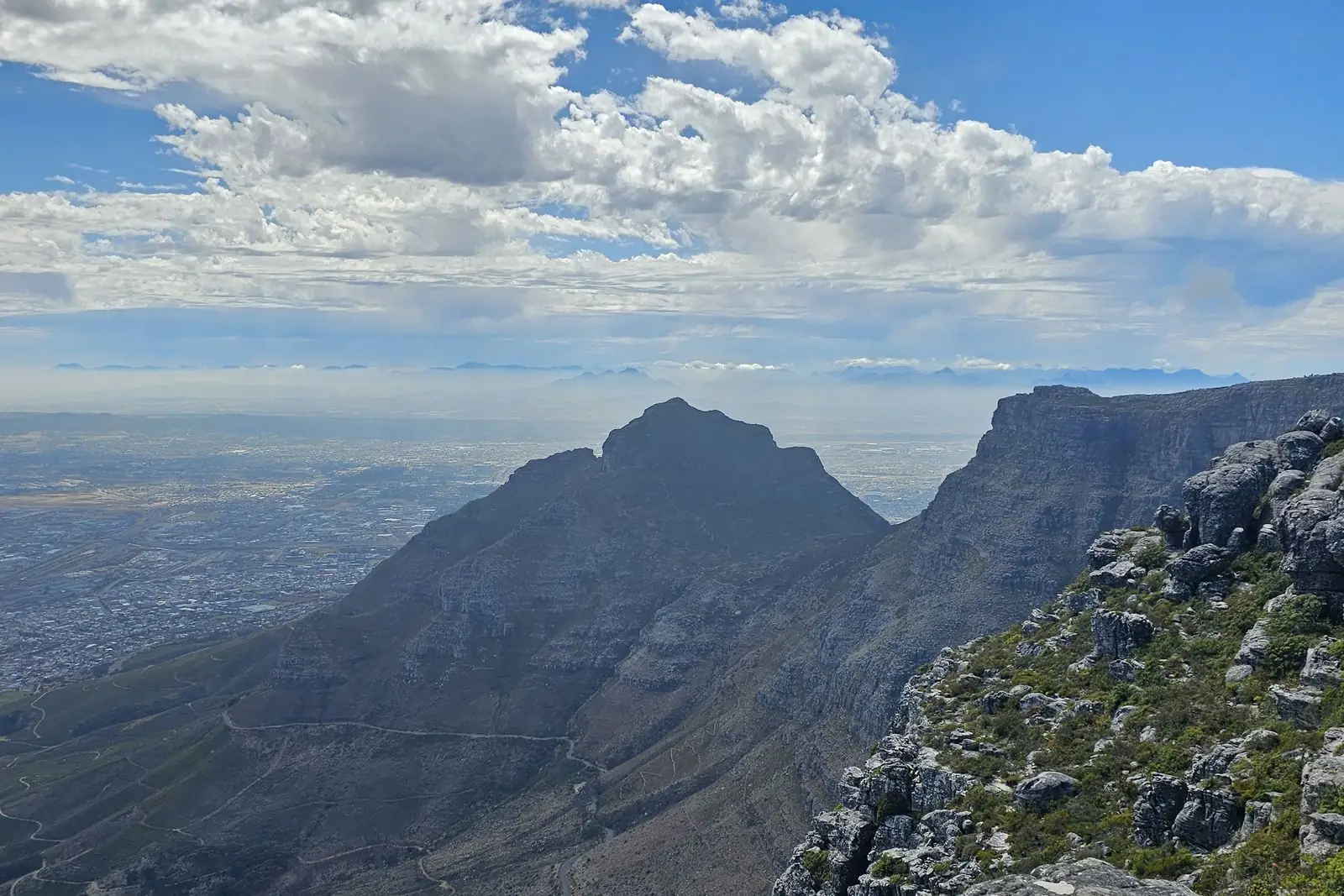
At the end of January 2026 three of us, me and two friends, flew to South Africa for two weeks: Cape Town, a safari in Kruger and the Garden Route. We planned the whole route ourselves. Then one friend flew home, and the two of us stayed to live in Cape Town. Here is everything you’ll need to plan a trip like this. The story itself is in the day-by-day chapters.
In short
How we planned
First we looked for tours, but they were all very expensive. Then we looked for someone to put a route together for us, because we had no time at all. For the route as we wanted it, they asked for about €500. And we decided we could easily make it ourselves, with ChatGPT.
Our format was this:
- pace: brisk and active, but with days to catch our breath, especially after flights;
- budget: comfortable, but not luxurious;
- who wants what: one wanted diving, another surfing, another a glass of wine at a café by the sea, and for every day there was an option with no activities;
- food: one of us is vegetarian and one doesn’t eat seafood.
First we drew up the route in broad strokes, then broke it down by day. We booked hotels and activities ourselves.
What to book in advance
The main things are logistics and Kruger. Everything else matters less.
- 4–8 weeks ahead: accommodation and everything connected with Kruger.
- 2–3 weeks ahead: domestic flights and the rental car. Diving and kayaking in Tsitsikamma are also better booked in advance: places can run out.
- A couple of days ahead: surf lessons.
- A day ahead: cable car tickets for Table Mountain, when the weather is clear. You can also buy them on the spot, you’ll just wait longer in the queue.
- On the spot: canoes in Wilderness, entry to nature reserves.
Route and logistics
Our route has three blocks: Cape Town and the peninsula, Kruger, the Garden Route, and Cape Town again at the end. Between blocks we took domestic flights: with a similar travel time we’d have chosen the road, but distances in South Africa are big.
- In Cape Town: only taxis (Uber). We hardly walked anywhere.
- To the Cape of Good Hope: with a driver for the whole day, so nobody has to drive all day.
- To Kruger: by plane, then a transfer.
- On the Garden Route: a rental car. We had only one driver.
What I’d do differently
- Via Johannesburg. It’s easier to get to Kruger from there: fly into Johannesburg for a day, then Kruger, then Cape Town. Going from Cape Town, the logistics turned out somewhat complicated.
- A car in Kruger too. Transfers there are very expensive; a car would have been much cheaper.
- Check the transfer in both directions. I thought ours was round trip, but it was one way.
More about Kruger is in a separate article.
Safety
This is very, very important. Cape Town is among the twenty cities in the world with the highest murder rates, for example, in the ranking by the Mexican Citizens’ Council for Public Security. So be very careful about everything.
Where to stay
This is a hard rule. Sometimes you find a cheap hotel, then look at where it is, and realise it’s really not fun. Look at the neighbourhood before you look at the price.
Neighbourhoods of Cape Town
Whole city
The centre, close-up
- Calmest — Atlantic coast, the peninsula, Constantia, wine regions
- Be more careful — City Bowl, Claremont and student areas, Blouberg, Somerset West and Strand
- Taxi only — the centre and Woodstock — no walking, especially in the evening; along the N2 — no stops
- Guide only — townships
- No colour — no information
- Calmest: the Atlantic coast (Green Point, Sea Point, Bantry Bay, Clifton, Camps Bay). Also Hout Bay, Constantia, the peninsula up to the Cape of Good Hope, the False Bay coast (Muizenberg, Kalk Bay, Simon’s Town with its penguins) and the wine regions.
- Be more careful: the City Bowl (Gardens, Tamboerskloof, Oranjezicht, Vredehoek), student areas (Observatory, Rondebosch), Claremont, plus Blouberg, Somerset West and Strand.
- Taxi only: the centre (CBD) and Woodstock. It’s fine to go there for something specific, but don’t walk around on foot, especially in the evening. And the N2 along the airport: it’s best to drive through without turning off anywhere.
- Only with a guide or a tour: the townships, for example Langa. We went there on an organised tour, and it was one of the most important days of the trip: here’s how it went.
Rules to follow strictly
- On foot, only in calm neighbourhoods. Everywhere else, only taxis.
- Don’t take your phone out, even in a car. Once we were taking a taxi to the centre, and my friend in the front seat took out her phone. A man immediately headed for the window. The driver barely managed to close it.
- Don’t go with strangers. In Bo-Kaap we nearly got scammed out of a whole basket of groceries: here’s how it went.
- In unsafe neighbourhoods, don’t look like a tourist. Don’t stop, don’t gawk and don’t photograph on the street; walk confidently. That’s what Namhla from Langa advised us.
- What to take with you: a hidden bag that goes under your clothes and a dummy phone.
Before you go, read the general safety advice for South Africa from the UK government, and your own country’s travel advice if it has one.
Money
We paid by card. You hardly need cash in South Africa: everything is very automated, and in some places cash isn’t even accepted, for example, for some tickets you can’t pay without a card. In most places you can pay in cash, but it’s unreliable and unsafe.
We needed cash only in Kruger, for tips for the rangers. We withdrew rand from ATMs.
Taxis in Cape Town are cheap: a ride along the Atlantic coast usually cost us 50–100 rand per car (≈ $3–6), to the airport 200–500 (≈ $12–31).
Tipping
It’s a must. Not leaving a tip here is bad form: it’s disrespectful to an established culture. If you don’t want to anger people, leave one.
- How much: we usually left about 10%.
- How: almost everywhere by card. When paying at the terminal you choose straight away what percentage to leave, or you pay the tip as a separate payment.
- Even for a juice. If you went up to the bar yourself and asked for a juice, they still expect a tip.
- In Kruger, in cash. Rangers on game drives from the camp expect cash. We didn’t know that, and it was very awkward: here’s how it went.
Connectivity and documents
A visa depends on your passport, so check the rules for your country before you go. I didn’t need one: Russian citizens can stay up to 90 days without a visa.
An eSIM we set up on the spot, quickly and without problems.
Language
English is good everywhere here, and it’s British English: the colonial past left its mark. Sometimes I got confused. I’m used to American “arugula”, but here it’s “rocket”. The same with shrimp and prawns, fries and chips. But overall it’s all fine.
The peoples of South Africa also have their own languages. In Langa we were told about Xhosa (isiXhosa), which has click sounds. Clicks are in Zulu too and, less often, in some other languages of the country. And there’s Afrikaans, but that’s a separate story.
Food and shops
We sometimes ate in restaurants and sometimes simply bought ready-made food in shops, and it’s very tasty there.
Of the supermarkets we only went to Spar and Woolworths. Spars vary. But Woolworths is really solid: people here love local, farm-produced food, and the products are genuinely very tasty. It’s worth it.
What the trip cost
How much it came to per person and what it consisted of is in the “Cost” block above the holiday route. I didn’t include international flights and food there: flights depend on where you’re flying from, and food is different for everyone.
Before you go
Before the trip it’s worth getting to grips with the safety rules, understanding how to behave and learning at least a little about the country’s culture and history.
Comments
I don’t ask for your email. I read every comment myself before it’s published.